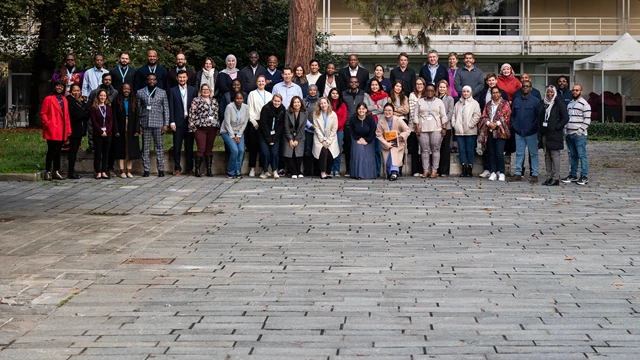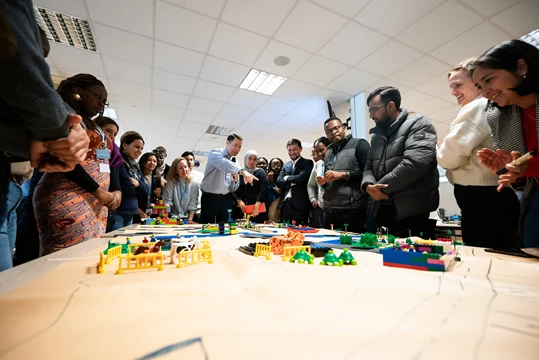
Earlier this month Faye and I found ourselves attending a training course, Project Management Professional Certificate Path, at the UN System Staff College - it was a pure bonus that the college is based in Turin, Italy.
Lifting shamelessly from the course guide, “this course walks participants through the nuts and bolts of project management, from setting priorities to controlling expenses and reporting on results. It provides support and practical activities and useful examples to help participants apply these skills in their daily work.” These skills are much needed in both our roles, as we are involved in many stages of UNHCR’s work in the field, from planning new projects, to forming indicators to monitor them, to conducting the activities, and to finally reporting on them.
Faye has recently experienced the cyclones in Bangladesh, which resulted in UNHCR declaring an emergency situation due to significant damage to refugee shelters and facilities in the camps. Natural disasters and extreme weather events such as this are not uncommon in Bangladesh, and often cause widespread damage and even loss of life amongst the refugee population. In such situations, it is important for UNHCR personnel to know how to rapidly respond to the situation, and adapt refugee projects to ensure that food, health, water etc. continue to be delivered to those who need it, particularly in a context such as Bangladesh where refugees are very reliant on the humanitarian community for their day-to-day needs. Coordination between UNHCR, other UN Agencies and other NGOs is crucial to operating successfully in the field.
In south Lebanon, I’ve been dealing with the new situation arising from the attacks in Israel and subsequent retaliation in Gaza since 07 October. Cross-border attacks along the southern Blue Line (the demarcation line of withdrawal between Lebanon and Israel) have become a daily occurrence with increased ferocity as the hostilities draw on into nearly their third month. So far more than 35,000 people have fled the border areas due to the intensity of the shelling and weaponry used, and more than 100 people in Lebanon have been killed, including 14 civilians. UNHCR has responded by donating items such as mattresses and blankets to help the displaced families, some of whom are taking shelter in schools and other municipal buildings. UNHCR is supporting the Government of Lebanon and other UN Agencies to appropriately plan for any further escalation, meaning more people could be on the move. It is an uncertain and unsettling time, and I hope that sense and calm prevails to stop the horrific violence.
The final day of the course we learned about the Agile approach to project management. This is a style that was developed from the software development world, but that can be applied to many situations. It involves shorter target times, two-weeks for instance, at the end of which something is produced, released, evaluated, and then improved over the next two weeks. This defies the prevailing approach in many organisations, including the UN, for year long plans and targets. Longer plans can become less flexible in an evolving context, whereas Agile allows you to adapt to fast-moving change. UNHCR operates in environments where change is constant, often from day-to-day, so it gives us plenty of food for thought!
The UNHCR JPO scheme of which we are both a part was set up to facilitate the entry of young professionals into humanitarian work, and places emphasis on professional development. As such, Faye and I are fortunate to have access to a training budget, which we used to take this course. Having the opportunity to meet with other UN staff from across the globe and engage in discussions about how to improve humanitarian project delivery was a valuable experience, and we came away with practical skills and knowledge that will support our work in Lebanon and Bangladesh.