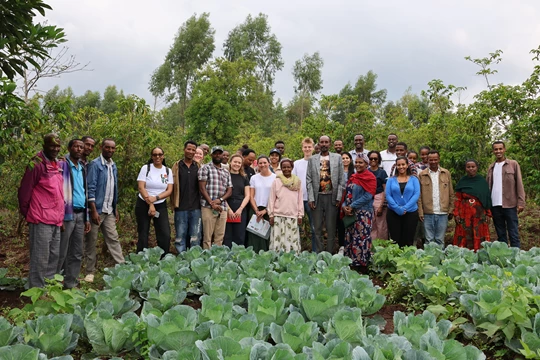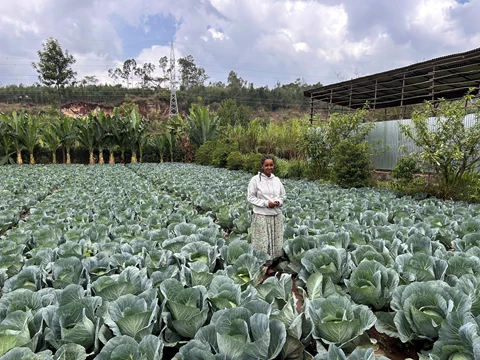

A smallholder cabbage farmer in Sidama, Ethiopia, discusses how access to financial services through project partner Lersha has supported her to grow her farming enterprise.
Credit: Lersha
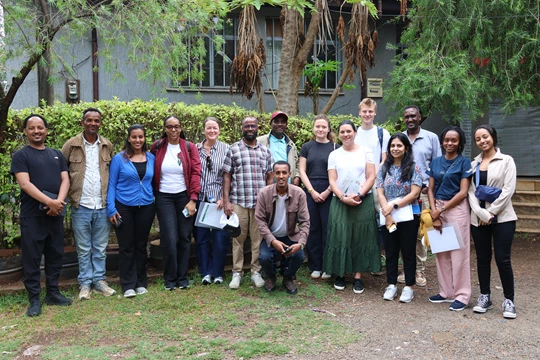
In March 2026, JOA undertook a mid‑point monitoring visit to Ethiopia to learn how Accion International and its partners are working to expand financial inclusion for low‑income women entrepreneurs. The project, Increasing Inclusion and Resilience for Vulnerable Ethiopian Women, supports small scale women‑led businesses across urban, peri‑urban and rural contexts through tailored, affordable financial solutions.
One clear learning emerged during the visit: while digital innovation plays an important role, progress towards women’s financial inclusion is shaped just as much by trust, relationships and practical, on‑the‑ground support.
Strengthening systems for long‑term inclusion
Delivered in partnership with Ethiopian fintechs Kifiya, Lersha and Jemla, the project focuses on strengthening the country’s existing financial ecosystem rather than delivering short‑term services. The partners operate in very different environments, from women smallholder farmers in Sidama Regional State to women‑owned micro and small enterprises in Addis Ababa. Despite these differences, they share a common aim: developing financial products that reflect women’s realities and can be sustained within local markets.
Within this this model Accion plays a catalytic role. Through targeted technical assistance, product design support and operational guidance, the project supports partners to refine their business models and improve service delivery. The focus goes beyond expanding outreach. It centres on building partner capacity so fintechs are better equipped to operate effectively and independently over time.
By the time of JOA’s visit, more than 2,600 women had accessed finance through the project, with many thousands more engaged through onboarding, training and digital business tools. While implementation has faced challenges, including operational constraints and early rollout delays, these experiences have informed adaptation and system strengthening. Throughout the visit, demand was clear for financial products that reflect women’s needs, including Sharia‑compliant options.
Digital tools grounded in trust
Across discussions with Accion, partner fintechs and women clients, a consistent message emerged. Digital tools are most effective when introduced alongside face‑to‑face engagement, particularly in the early stages. In response, Accion’s partners continue to develop accessible digital platforms, from online marketplaces to information services, supported by strong client relationships and training delivered through a blended approach. This combines in‑person interaction with simple digital touchpoints, ensuring women are supported as they begin using new services.
In Sidama, Lersha’s agent‑led model plays a central role. Agents are embedded within the communities they serve and act as trusted points of contact. They support women smallholder farmers to understand available products, including agricultural loans bundled with essential farming inputs, navigate onboarding and address questions as they arise. Many women farmers shared that these relationships gave them the confidence to engage with credit and input financing for the first time.
Lersha agents also play an important role beyond financial access, helping link women farmers to markets by facilitating connections with off‑takers and supporting them to secure competitive prices for produce such as cabbages.
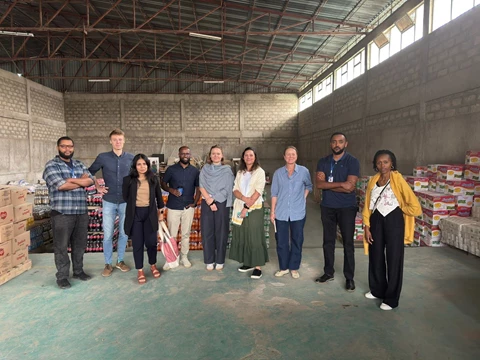
In urban areas, the touchpoints look different but serve the same purpose. Jemla’s business development officers and call centre teams provide hands‑on support to women retailers, primarily those operating in fast‑moving consumer goods such as household essentials. Kifiya’s approach is delivered through bank staff, who support women entrepreneurs to access input‑based loans through the digital HalalGebeya marketplace. Clients visited included restaurant, shop and hair salon owners.
Women’s engagement with financial services reflects everyday realities, including literacy levels and access to devices. A clear insight from the visit was that when digital tools are introduced alongside trusted, human support, women are more likely to use them and to continue engaging over time.
Learning beyond the project
As the project looks ahead, there is confidence that the building blocks for sustainable scale are in place. Across all locations visited, women expressed strong demand for financial products that are affordable, appropriate and responsive to their circumstances, including Sharia‑compliant options. This consistency reinforces the project’s close alignment with the realities of the women it aims to serve and its potential to support lasting access to finance.