

Ahmed Nejib, 36, takes care of the olive seedlings which he adopted while one of his sons Mohammed enjoys being around. Haro Dumal Town, Berbere District, Oromia Region, Ethiopia, February 2026.
Credit all images: WaterAid/Frehiwot Gebrewold
I recently travelled to Ethiopia with the Conservation Livelihoods Technical Specialist from Durrell, to visit WaterAid and MELCA Ethiopia staff and community members involved in ECOSAVE – a JOA-funded project that combines water security, soil restoration, and community led conservation. The purpose of our project visit was to spend time with the people at the heart of the work, to understand what is progressing well, and hear directly from those leading change in their communities. Over four days, the groups we visited included farmers, Water User Associations, tree nursery managers and local government representatives.
Many of JOA’s Conservation Livelihoods projects share similar themes – strengthening local leadership and management of natural resources, introducing nature-based solutions that restore degraded land, and livelihood opportunities that encourage long-term environmental stewardship – all reinforcing the link between human wellbeing and healthy ecosystems. ECOSAVE demonstrates the effective application of all of these themes, but one aspect of the project takes a novel approach to try to change people’s views of tree planting, shifting attitudes toward a sense of care and responsibility in an effort to strengthen community commitment to protecting biodiversity.
Guddifachaa, in its literal sense, refers to adoption: the act of taking someone or something into one’s family and care. It is an idea woven deeply into Oromo culture, carrying expectations of protection, responsibility, and continuity. What ECOSAVE has done is to apply that same cultural logic to environmental stewardship – specifically through tree adoption. Rather than relying solely on the planting of trees in Community Conservation Areas – plots of degraded land that have been earmarked by communities and local government for reforestation – community members are also invited to ‘adopt’ individual trees for planting around their homes. The adopters take personal responsibility for their growth and long-term protection, with the eventual benefits of tree products, shade and soil integrity being felt close to home.
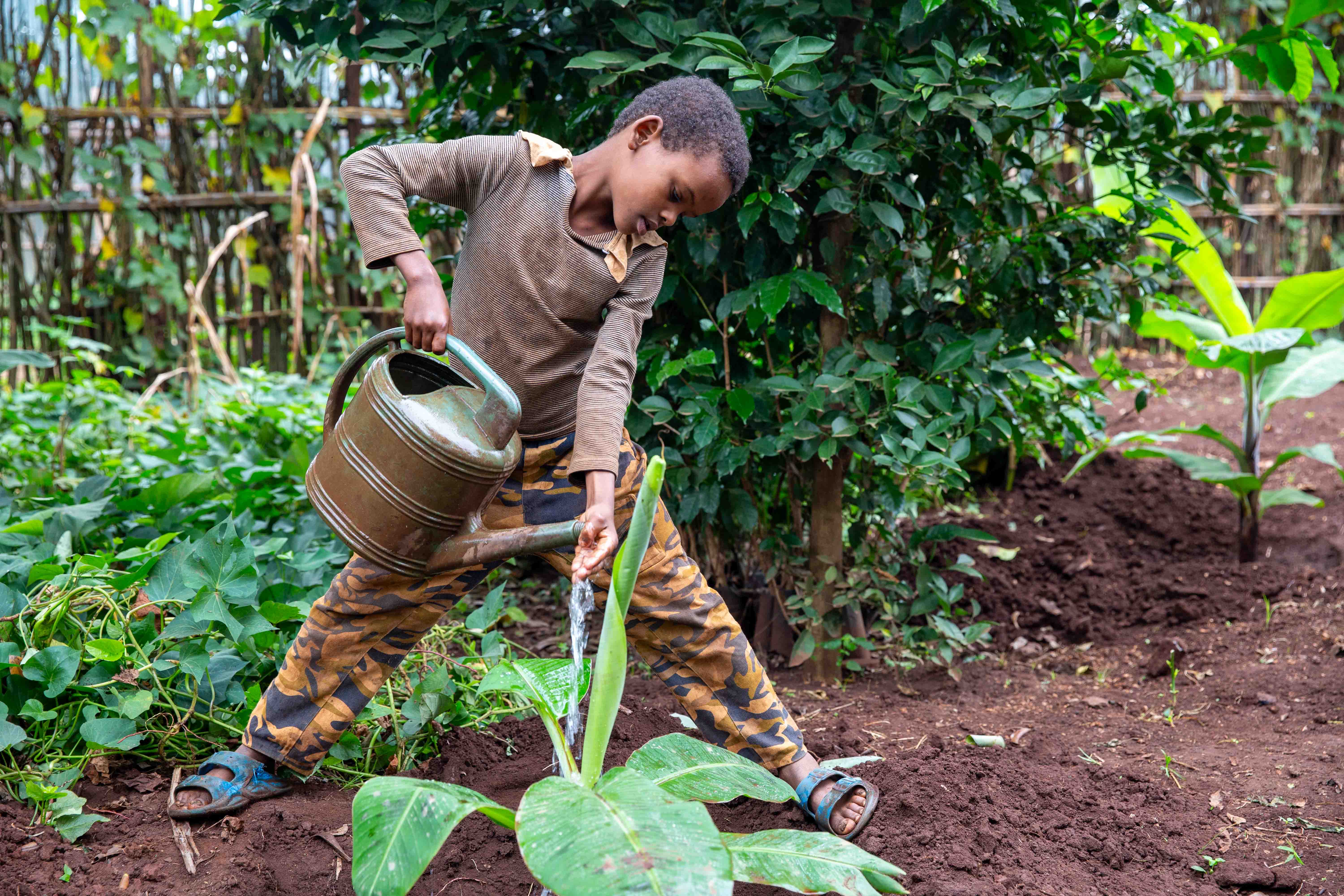
Mawiya, 13, Ahmed's first born, taking care of the plants in the backyard, Gebe Keko Kebele, Berbere District, Oromia Regional State, Ethiopia, August 2025.
One conversation with a farmer who had chosen Olea Africana saplings outlined how his decision was shaped by the tree’s locally threatened status, the medicinal purposes of its leaves and for a desire to maintain trees around his home for future generations. He explained the increasing scarcity of the species due to demand for timber, and his wish to see it restored in the landscape. Through guddifachaa, more than 5,000 seedlings have already been adopted, each cared for by a person who sees the tree not as a project asset but as their own.
The seedlings begin their journey in the project’s women-led tree nurseries. Visiting nine of the women who run one of these nurseries in Gebe Keku, they shared the knowledge they had gained through technical training, and their determination to build a sustainable business. Across three nursery sites, ECOSAVE has trained and provided the equipment for 45 women to grow a range of indigenous and endemic species, providing a supply of new saplings for the project’s reforestation and guddifachaa activities. The nurseries have already generated meaningful income, with many women reinvesting their profits in livestock to diversify their income. While the women discussed their thoughts about sustaining this income beyond the project’s lifespan, there are ideas to branch out into different tree species, including fruit trees that are in high demand. There is a sense of pride in the work of these nurseries, which will feed directly into the planned restoration of nearly 300 hectares of community land over the course of this project.
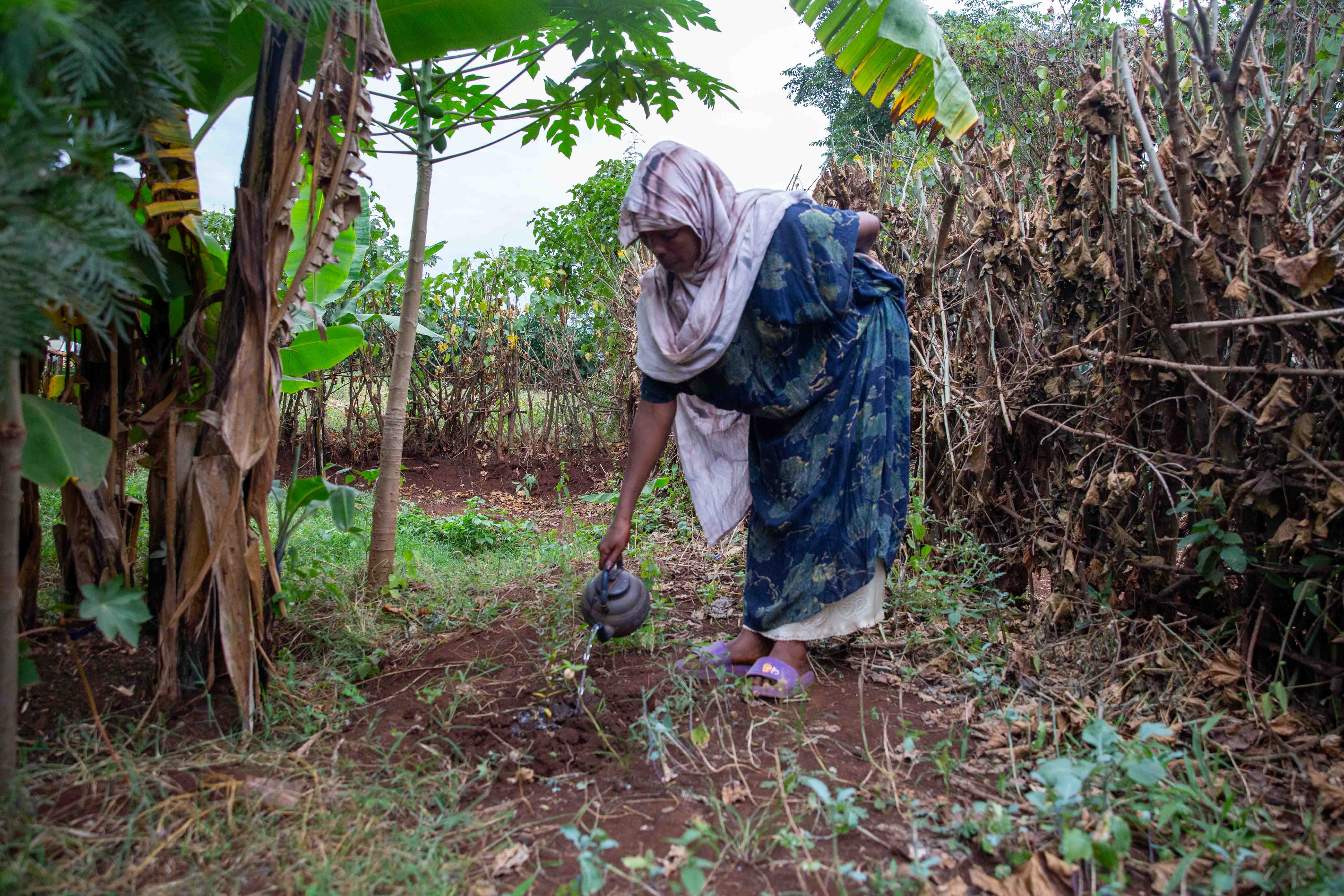
Halima Kedir, 30, watering the olive seedling she adopted from MELCA Ethiopia, a local partner to WaterAid Ethiopia in implementing its Eco-Save project, Haro Dumal Town, Berbere District, Oromia Regional State, Ethiopia, August 2025.
The landscape restoration efforts do not stop at planting trees – community members have also been contributing their time to soil and water conservation measures, particularly in areas suffering from severe erosion. Farmers described how the erosion of deep run-off gullies in heavy rain has threatened their farmland, livestock, and even the safety of fellow community members, and how earlier attempts to prevent erosion using sandbags had offered only temporary relief. Through ECOSAVE, they have now received support from WaterAid, MELCA Ethiopia and local government to construct durable check dams to help retain soil upstream of one of the most severely impacted gullies.
To protect the land from degradation and the soil from erosion, WaterAid is constructing retaining walls through its Eco-Save project in Sirima village. Sirima Kebele, Berbere District, Oromia Region, Ethiopia, February 2026.
What struck me throughout these discussions was how naturally guddifechaa complements the project’s broader conservation aims. By grounding environmental restoration in a familiar cultural practice, it has helped strengthen behaviour change in ways that feel organic, rather than imposed. People spoke about trees not just as resources but as responsibilities; about the importance of protecting restored areas; and about how these efforts will influence local water availability, soil health and agricultural productivity in the years to come. The idea of adoption, on top of all the actions ECOSAVE had enabled so far, seems to have deepened the connection individuals feel toward the natural environment, reinforcing the practical training and collective work already underway.